


























Commencement of Development and Verification of an Offline Disaster Response Support System Utilizing Small Language Models (SLMs)
Harnessing Generative AI to Enhance the Disaster Response Capacity of a Crisis Management Center Overseeing Approximately 200 Office Buildings
April 15, 2026
Mitsui Fudosan Co., Ltd.
Hitachi, Ltd.
Key Points of this Press Release
- Joint development of a disaster response support system featuring SLMs capable of operating during communication outages to establish a framework that ensures the Crisis Management Center continues to operate during disasters.
- Entering information on the extent of damage based on various facilities and conditions at each building will enable AI to extract response procedures from an extensive database of manuals. The system presents initial response procedures in order of priority to support decision-making that does not rely on the proficiency level of the on-duty staff.
- The initiative combines Mitsui Fudosan’s crisis management expertise with Hitachi’s experience and AI technology regarding building solutions. It aims for full-scale operation following proof-of-concept, with future expansion to other businesses in sight, to contribute to creating sustainable and resilient communities.
Tokyo, Japan, April 15, 2026 – Mitsui Fudosan Co., Ltd., (Mitsui Fudosan) a leading global real estate company headquartered in Tokyo, and Hitachi, Ltd. (“Hitachi”) have begun development and verification of an offline disaster response support system (“the System”) that utilizes SLMs (Small Language Models), which are a type of generative AI. This initiative aims to further strengthen disaster response capacities at Mitsui Fudosan’s Crisis Management Center, a facility that oversees approximately 200 office buildings across Japan. This System has incorporated specialized expertise in building operations and disaster response into the AI to ensure accuracy sufficient for practical use, even in on-premises environments*1. Through Hitachi’s professional services for generative AI, the initiative will leverage business-specific language models*2 and AI agents*3 to establish a disaster response support system that can be used on site. The two companies are currently moving ahead with proof-of-concept for this system, aiming for early full-scale deployment after technical verification and refinement. Through also aiming to position the System as part of Hitachi’s HMAX for Buildings lineup, the advanced outcomes of the joint efforts by both companies will be offered to other building management operators, contributing to the creation of sustainable and resilient communities.
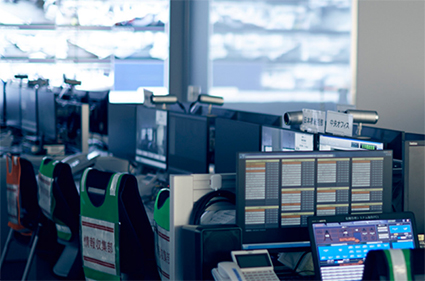
Mitsui Fudosan’s Crisis Management Center
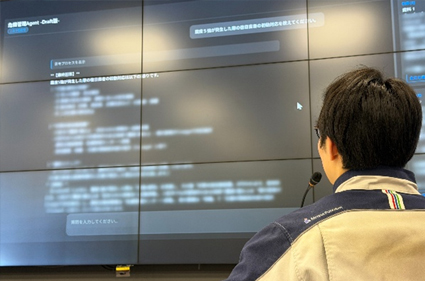
Screenshot of the offline disaster response support system currently under testing
- 1 A model in which a company or other organization deploys and uses a system that utilizes their own facilities, such as servers, and software.
- 2 August 29, 2024, Hitachi press release: “Commencement of ‘Business-Specific LLM Development and Operation Services’ Toward Full-Scale Practical Application of Generative AI.” https://www.hitachi.com/ja-jp/press/articles/2024/08/0829a/ (in Japanese)
- 3 March 26, 2025, Hitachi press release: “Leveraging OT Knowledge Accumulated From Hundreds of Cases, Hitachi Rapidly Delivers Customized AI Agents to Customers.” https://www.hitachi.com/ja-jp/press/articles/2025/03/0326/ (in Japanese)
■ Significance of Developing This System
As natural disasters become increasingly extreme and the working-age population continues to decline, ensuring both safety and security along with improving efficiency while saving labor has become an urgent priority. Mitsui Fudosan’s Crisis Management Center is a permanent hub that operates 24 hours a day, 365 days a year, with two on-duty staff working in shifts. In the event of seismic intensity of 5-upper or higher on the Japanese scale, a disaster response headquarters will be established within the Center, coordinating with regional response headquarters on a scale of some 300 staff members. Information from across the country will be centrally managed to swiftly provide information to building users, and to maintain or restore building functions.
Meanwhile, restrictions on landline, mobile telephone, and internet connectivity may arise in large-scale disasters, a system that neither relies on communication networks nor depends on the proficiency level of on-duty staff was required.
In light of this, under the belief that having on-duty staff at the Crisis Management Center able to respond appropriately, even in large-scale disasters that involve communication disruptions, results in the safety and security of building users, Mitsui Fudosan and Hitachi have begun to develop and verify an offline disaster response support system. This system utilizes SLMs to ensure provision of accurate support regardless of the communication environment.
■ Strengths and Roles of Both Companies in System Development
Mitsui Fudosan provides on-site expertise in crisis management cultivated through operating approximately 200 office buildings, along with an extensive database of operational and disaster response manuals, and BCP/BCM governance, while taking the lead in evaluation and defining requirements. Optimal response and operational feasibility are ensured through a fine-tuned system tailored to the Crisis Management Center’s actual operations.
Hitachi designs and deploys lightweight and reliable offline AI systems by applying its knowledge of building facilities (including elevators) and control center operations. It also employs its development strengths in next-generation solutions, such as the HMAX for Buildings, which combines domain expertise and advanced AI with data to generate new value. Mitsui Fudosan’s advanced requirements were met through an architecture rooted in strict security standards and mission-critical operations cultivated by the Digital Systems & Services sector for financial services and other fields.
■ System Features
- A system architecture that utilizes generative AI in offline environments
A system that operates within a local environment was implemented to handle the possibility of network outages and external server failures in the event of a large-scale disaster. The constructed framework does not rely on cloud connectivity and enables continuous decision-making at the Crisis Management Center. On this framework, generative AI (SLMs) will organize information necessary for decisions about initial response and propose solutions to support decision-making for Center personnel. - Automatic provision of initial response guidance specialized for disaster response operations
By entering information on the extent of damage to each building through devices such as smartphones, generative AI searches and interprets a vast database of disaster response manuals, and provides Center personnel with actions and tasks they should prioritize. The system offers support tailored to the specific needs of each building, reflecting differences in location and facility configuration. - Handing down the experience of seasoned personnel as organizational strengths
To prepare for on-site situations that transcend what is covered in manuals, generative AI has been trained beforehand with expertise from seasoned personnel and know-how from past responses. This enables swift and accurate initial response that does not rely on the proficiency level of the on-duty staff. - Utilization of VLM and fine-tuning to support high-quality responses
Even during large-scale disasters, the System will deliver response accuracy and speed on par with general-purpose large language models. It also provides the source information of manuals it references when providing answers, enabling decision-making while confirming the basis of each recommended course of action, achieving high performance in terms of explanation. To improve the System’s accuracy, a VLM (Vision Language Model) has been implemented to incorporate information referenced from manuals in charts and tables. Furthermore, fine-tuning was conducted for the model using manuals and past Q&A data in order to train the AI with specialized knowledge about disaster response and response formats required on site. This was done to create response capabilities that are optimal for the Crisis Management Center’s operations.
The SLM adopted in the System is a lightweight model compared to general-purpose LLMs (large language models), and can operate on standard computers and smart devices. This simultaneously achieves the following: 1. Operational continuity during communication disruptions (no cloud required); 2. protection of intellectual property and confidential information (by not storing highly confidential manuals and operation information externally); and 3. highly precise optimization for specific operations (through focused learning on Mitsui Fudosan’s specialized
■ Future Initiatives
Mitsui Fudosan, aiming to both improve productivity and strengthen added value by using generative AI, acquired a ChatGPT Enterprise license on October 1, 2025, and is currently rolling it out to all of the Company’s approximately 2,000 employees. The Company plans to gradually expand the scope of generative AI application to enhance management decision-making, address on-site labor shortages, and integrate with data analysis. The aim is to achieve a higher level of added value creation as the needs of society and customers become increasingly diverse and sophisticated.
Urban Solutions&Services Business Unit of Hitachi’s Connective Industries (CI) Sector provides facility services that maximize lifetime value for customers and transform industries globally, contributing to a prosperous society. We achieve this through the combination of strong products and HMAX for Buildings, a next-generation suite of solutions that combine data from an extensive installed base of digitalized assets with domain knowledge and advanced AI.
Following the proof-of-concept phase, Mitsui Fudosan and Hitachi aim to operate the System at the Crisis Management Center at full scale while also providing the insights obtained from this initiative to other office building management operators, thereby contributing to the creation of sustainable and resilient communities.
■ About Mitsui Fudosan
Under the philosophy of “To generate new value through cooperation, coexistence and co-creation,” Mitsui Fudosan promotes neighborhood creation by leveraging diverse assets that include office buildings, commercial facilities, residential properties, hotels, and logistics facilities. With a focus on urban development, the Company strives to solve social issues, such as improving industrial competitiveness, coexisting with the environment, and enhancing well-being through building management, area management, and utilization of digital technologies. Furthermore, Mitsui Fudosan contributes to the realization of sustainable and thriving cities by, together with its customer base, leveraging extensive assets, which include office buildings across Japan, to promote initiatives that foster corporate networking and creation of new value
■ About Hitachi
Through its Social Innovation Business (SIB) that brings together IT, OT (Operational Technology), and products, Hitachi contributes to a harmonized society where the environment, wellbeing, and economic growth are in balance. Hitachi operates globally in four sectors – Digital Systems & Services, Energy, Mobility, and Connective Industries – and the Strategic SIB Business Unit to establish new growth businesses. With Lumada at its core, Hitachi generates value from integrating data, technology, and domain knowledge to solve customer and social problems. Revenues for FY2024 (ended March 31, 2025) totaled 9,783.3 billion yen, with 618 consolidated subsidiaries and approximately 280,000 employees worldwide. Visit us at www.hitachi.com/en/
■ Trademark Notice
The company names and product names referenced herein are trademarks or registered trademarks of their respective companies.