

























Official Launch of a Robot Delivery Service at Tokyo Midtown Yaesu
Provision of a New Experience that Links In-Building Restaurants and Offices with LINE Orders and Digital Twin Technology
July 21, 2026
Mitsui Fudosan Co., Ltd.
NTT EAST, Inc.
NAVER Cloud Corporation
Key Points of this Press Release
- Official launch of a robot delivery service at Tokyo Midtown Yaesu, which delivers food and drinks from in-building restaurants to offices through LINE orders.
- Utilizing a cloud-based digital twin, deliveries can be made to multiple floors through coordination with in-building security doors and elevators.
- The delivery robots use physical AI technology, which perceives the real world and moves according to its own decisions. Through AI that combines camera imagery with the digital twin, the system achieves smooth and autonomous navigation, even within the complex buildings and crowds of Midtown Yaesu.
- The three companies will also expand the digital twin beyond robot delivery to facility management DX as a whole, including building management operations.
Tokyo, Japan, July 21, 2026 - Mitsui Fudosan Co., Ltd., a leading global real estate company headquartered in Tokyo, NTT EAST, Inc., and NAVER Cloud Corporation launched a robot delivery service (hereafter, “the Service”) at Tokyo Midtown Yaesu. The service features delivery robots leveraging physical AI*1, which perceives the real world for autonomous navigation, and will deliver food and drinks from in-building restaurants to offices.
The Service will have robots delivering items from the Tokyo Midtown Yaesu B1 and fifth-floor restaurants to WORKSTYLING Tokyo Midtown Yaesu on the seventh floor. Office workers will be able to order items using LINE, an app they use daily, and easily receive the items from restaurants in the building at convenient times, such as between meetings and work tasks, without even needing to leave the office.
The delivery robots use a cloud-based digital twin*2 as a “digital map” they share with each other. The robots have a full grasp of the interior layout and navigation routes in digital space, and are linked with security doors and elevators, which enables them to make deliveries across multiple floors, even in a large-scale, mixed-use facility such as the Tokyo Midtown Yaesu.
This initiative is a state-of-the-art facility management DX that utilizes delivery robots powered by physical AI to improve convenience for office workers and promote the patronage of in-building restaurants while using the digital twin to advance operations at the large-scale, mixed-use complex.
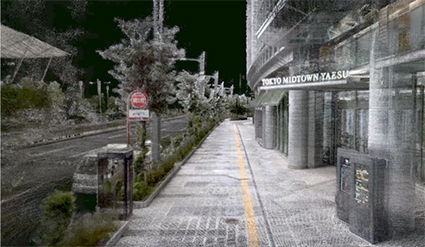
Image of the Tokyo Midtown Yaesu entrance recreated by the digital twin
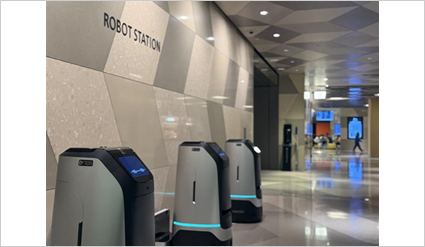
Delivery robots at their B1 floor station in Tokyo Midtown Yaesu
- 1 The general term for technology that perceives the real world through cameras and sensors and has AI take action according to its own decisions. The Service combines simulation-based learning on the digital twin with real-world environmental data to achieve autonomous navigation by robots.
- 2 Technology that recreates real-world spaces and facilities within a digital space and uses this to monitor facility status and operate services. In the Service, this technology is utilized as a “digital map” for robots to navigate the building.
1.Background and Objectives
Tokyo Midtown Yaesu is a large-scale, mixed-use complex*3 featuring commercial facilities, offices, a bus terminal, and a hotel, among other facilities. As a place frequented by a diverse range of visitors, improving convenience for office workers, promoting the patronage of in-building restaurants, and boosting the efficiency of facility operations have become key themes.
Mitsui Fudosan and NTT EAST have been conducting proof of concept testing at Tokyo Midtown Yaesu towards utilizing the digital twin technology for large-scale, mixed-use facilities. The initiative explores usage scenarios across multiple applications, such as delivery robots and AR navigation. The two companies have now been joined by NAVER Cloud, which has cloud and AI technology platforms and expertise in a wide range of technologies, including digital twins and physical AI. The three companies are leveraging the know-how gained from their efforts to date and plan to launch a delivery robot service in real-world facility operations to provide full-fledged in-building deliveries to users.
Through this service, office workers will be able to easily receive food and drinks from in-building restaurants from the comfort of their own office, creating new sales opportunities for restaurants through office deliveries. Furthermore, the initiative will also expand the potential for new services and improve the operational efficiency of facility operations through the use of digital twin technology.
*3 A large-scale complex with multiple uses that integrates diverse urban functions
2.Service Overview and Characteristics
The Service offers an in-building delivery service in which robots deliver food and drinks from selected restaurants*4 on the B1 and fifth floors of Tokyo Midtown Yaesu to office workers at WORKSTYLING Tokyo Midtown Yaesu on the seventh floor. A total of four delivery robots will be in service, three on the B1 floor and one on the fifth floor.
Office workers will be able to make orders through the LINE app. Delivery robots will pick up items once the restaurant receiving the order is ready, and through coordination with security doors and elevators, the items will be delivered to the designated location for pick-up.
*4 The selected restaurants are FRIJOLES, pork tamago onigiri, Torikai Souhonke, Chiiran Tantanmen, and Tokyo Yaesu Chikaba Kitchen. (As of July 21, 2026)
Characteristics of the Service
- Simple usability through easy LINE ordering
Office workers will be able to order items using LINE, an app they use daily. The Service does not call for any dedicated devices or complex operations, enabling users to receive items from in-building restaurants between their meetings and work tasks from the comfort of their offices. - Robots deliver items across multiple floors.
Delivery robots pick up items from restaurants on the B1 and fifth floors and deliver them to the WORKSTYLING Tokyo Midtown Yaesu on the seventh floor. Through coordination with security doors and elevators within the facility, the robots are able to make their deliveries across multiple floors. - Physical AI achieves smooth, autonomous navigation within complex facilities.
The Service incorporates physical AI technology, in which delivery robots recognize their location and surroundings by analyzing camera images with AI to enable autonomous decision-making and navigation.
Through repeated simulation of robot navigation on the digital twin and training robots in advance to address various situations, the Service enables robots to smoothly navigate the busy large-scale, mixed-use complex while being aware of people moving about the building.
The digital twin also functions as a “digital map” shared between multiple robots. This allows the robots to adapt to changes in the layout of the facility by simply updating the “digital map” on the cloud, enabling smooth operations in a facility that often undergoes layout changes and holds a variety of events.
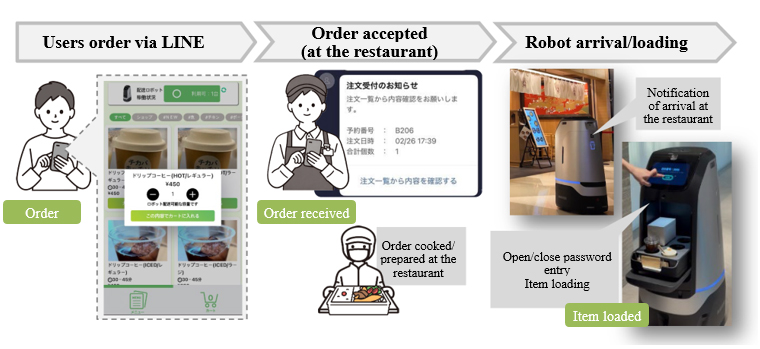
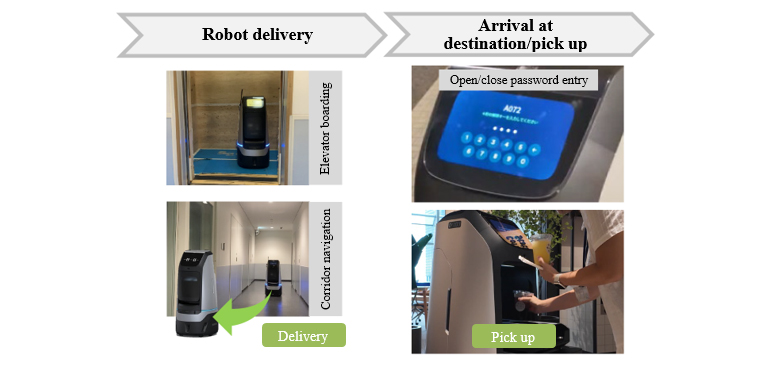
The flow from LINE ordering to delivery
3.Role of Each Company
| Mitsui Fudosan | Provision of the delivery robot service at Tokyo Midtown Yaesu, coordination with facility operations |
|---|---|
| NTT EAST | The development, construction, management and operation of the digital twin environment and delivery robots |
| NAVER Cloud | Technology provision and support for the digital twin delivery robot platform using physical AI, robot control, and operation |
4.Future Prospects
The three companies will also take into consideration the utilization of the digital twin for other tasks, including building management operations. Starting from Tokyo Midtown Yaesu, the aim is to provide a more convenient and comfortable facility experience for office workers and visitors while utilizing cutting-edge DX technologies such as physical AI and digital twins to realize next-generation facility management DX that connects robots, restaurants, offices, and facility equipment.