





















Collaboration between Mitsui Fudosan and TEPCO Energy Partner Completion of Nihonbashi 1-chome Energy Center
Electricity and Heat Supply Begins at Tokyo Midtown Nihonbashi, Supporting Environmentally Advanced and Resilient Urban District Development
Local Energy Production for Local Consumption Cuts District-Wide CO2 Emissions by Approximately 25%
October 8, 2026
Mitsui Fudosan Co., Ltd.
TEPCO Energy Partner, Inc.
Key Points of this Press Release
- The Nihonbashi 1-chome Energy Center was completed on September 30, 2026 and began supplying electricity and district heating and cooling to Tokyo Midtown Nihonbashi on October 1.
- A cogeneration system (hereafter, “CGS”) enables local energy production for local consumption. In addition to the adoption of high-efficiency equipment and utilization of waste heat, equipment operation is optimized using an AI-based energy management system, reducing CO2 emissions by approximately 25%.
- Large-scale CGS units and a multiple-line power reception system enhance the Business Continuity Plan (hereafter, “BCP”) capabilities and overall value of the entire district. Energy supply can be maintained even during widespread power outages.
- Through the continued introduction of new technologies and promotion of various initiatives, the project aims to achieve net-zero CO2 emissions across the entire district and lead the way to carbon neutrality by 2050.
Tokyo, Japan, October 8, 2026 - Mitsui Fudosan Co., Ltd., a leading global real estate company headquartered in Tokyo, and TEPCO Energy Partner, Inc., an energy retailer also based in Tokyo (hereafter, “TEPCO EP”), announced today that Mitsui Fudosan TEPCO Energy Co., Ltd. (hereafter, “Mitsui Fudosan TEPCO Energy”), a joint venture they established in April 2023, completed the Nihonbashi 1-chome Energy Center on September 30, 2026.
The Nihonbashi 1-chome Smart Energy Project (hereafter, “the Project”) commenced operations on October 1, 2026, providing a stable electricity and heat supplyto the entire Tokyo Midtown Nihonbashi district (completed on September 30, 2026), a large-scale mixed-use development with offices, retail facilities, a hotel, rental residences, MICE facilities, and other urban functions. The Project will help create a sustainable and highly competitive urban district in Nihonbashi that combines energy efficiency and environmental performance in normal conditions with resilience in emergencies.
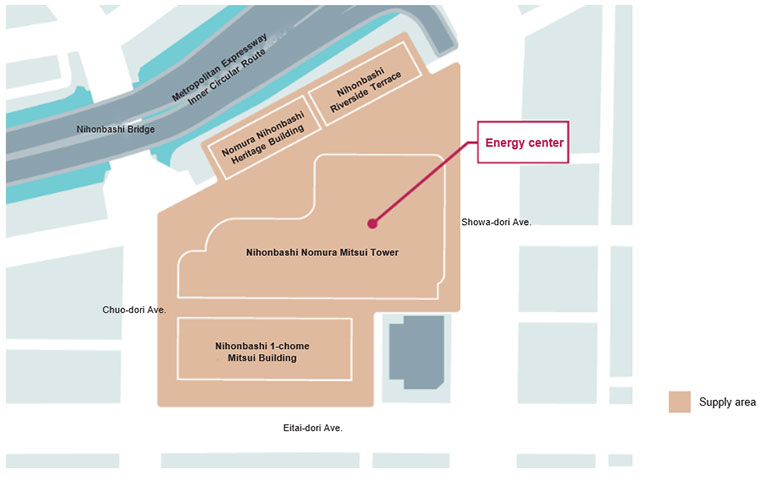
Nihonbashi 1-chome Energy Center supply area
■Completion of the Nihonbashi 1-chome Energy Center
The Project is an initiative to enable local energy production for local consumption through the efficient electricity and heat supply within the district. To this end, Mitsui Fudosan TEPCO Energy has established the Nihonbashi 1-chome Energy Center, an independent and decentralized energy center located within Nihonbashi Nomura Mitsui Tower, the main tower of Tokyo Midtown Nihonbashi. On October 1, 2026, the center began supplying electricity and heat to the entire Tokyo Midtown Nihonbashi district, including the Nihonbashi 1-chome Mitsui Building (completed in 2004) and the Nomura Nihonbashi Heritage Building (completed in 1930), a designated tangible cultural property of Chuo City.
■ Local Production of Energy for Local Consumption Contributes to Energy and CO2 Savings (Decarbonization)
The Project combines CGS units, heat recovery chillers, thermal storage tanks, and other equipment to efficiently generate and utilize electricity and heat within the district.
The CGS units generate electricity from city gas and supply it to the district. Waste heat from power generation is used to produce chilled water, hot water, and steam for cooling and heating within the district. The heat recovery chillers can produce not only chilled water for cooling but also hot water, switching efficiently between cooling and heating according to demand. The thermal storage tanks store chilled and hot water produced at night and other low-demand periods for use when demand rises, shifting the timing of heat production and consumption for more efficient equipment operation.
Combining these different types of equipment enables local energy production for local consumption by efficiently generating, sharing, and utilizing electricity and heat within the district. Compared with each building having its own supply equipment, this increases district-wide energy efficiency, reducing CO2 emissions by approx. 25%.
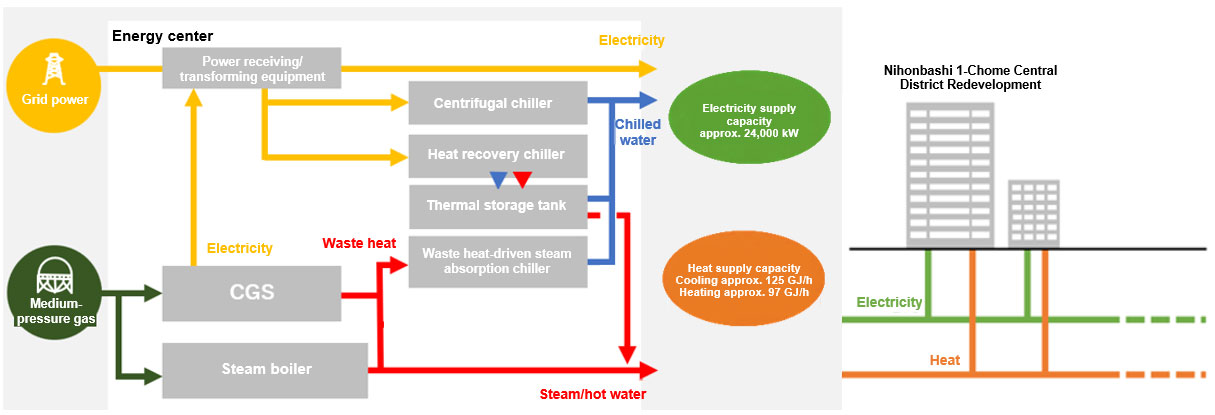
Energy flow diagram
Click illustration to enlarge
■ Automated Optimal Operation Achieved through an AI-Based Energy Management System
The Project has introduced EMSTEP®*1, an AI-based energy management system developed by TEPCO EP, for the operation of the energy center. In recent years, building energy operations have required increasingly sophisticated management to balance energy conservation with stable supply while also utilizing renewable energy and responding to electricity supply and demand conditions to meet society’s demand for decarbonization. EMSTEP® analyzes diverse data in real time, including renewable energy generation forecasts, DR requests*2, and electricity supply and demand conditions, to forecast electricity and heat demand with high accuracy at 30-minute granularity up to 30 hours ahead. Based on these forecasts, it automatically generates and executes optimal equipment operation plans, supporting efficient and stable energy operations.
The introduction of EMSTEP® optimizes energy use across the entire Project while also reducing CO2 emissions, labor requirements, and costs, contributing to sustainable energy operations.
Reference: Development of an Energy Management System Using AI Technology (EMSTEP®) (announced October 12, 2023)
https://www.tepco.co.jp/ep/notice/pressrelease/2023/1666303_8668.html (in Japanese)
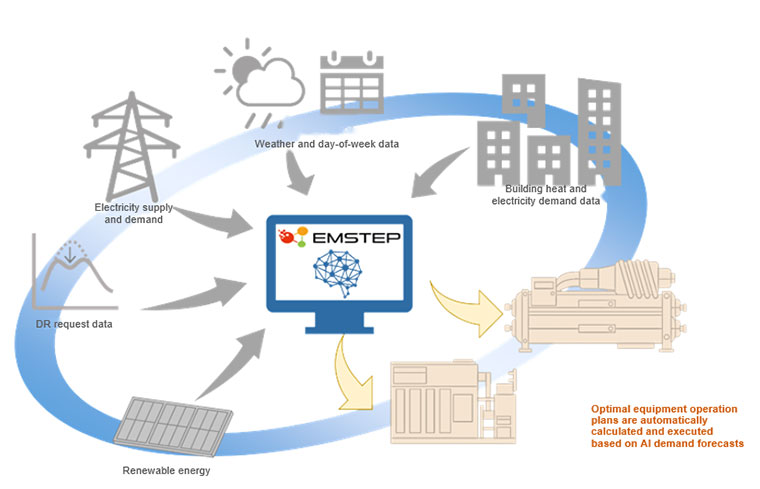
EMSTEP® conceptual diagram
- 1 EMSTEP® is a registered trademark of Tokyo Electric Power Company Holdings, Inc. (Registration No. 6863545).
- 2 DR requests (demand response requests): A mechanism whereby electricity customers reduce or shift their electricity use in response to requests from electric utilities and others in order to maintain the balance between electricity supply and demand.
■ Helping to Enhance District-Wide BCP Capabilities and Overall Value of the District
To ensure a stable energy supply during disasters, the Project deploys large-scale CGS units fueled by city gas from highly earthquake-resistant medium-pressure gas pipelines, which experienced no gas leaks even during the Great Hanshin-Awaji Earthquake and Great East Japan Earthquake. As a result, even if grid power fails, stable power generation can continue as long as the city gas supply is maintained, enhancing energy supply continuity for the entire district during disasters.
To ensure a stable energy supply during disasters, the Project deploys large-scale CGS units fueled by city gas from The energy center has also adopted a multiple-line power reception system. If a disaster or other event disables some incoming power lines, electricity can still be received through other lines. This system provides a high level of supply reliability across a wide range of voltage levels, from low voltage to extra-high voltage.
To ensure a stable energy supply during disasters, the Project deploys large-scale CGS units fueled by city gas from In addition, flood protection measures, including the installation of watertight doors, are in place to prevent water from entering the plant during heavy rainfall, river flooding, and other disasters.
To ensure a stable energy supply during disasters, the Project deploys large-scale CGS units fueled by city gas from In a disaster, electricity will also be supplied to public facilities in the district that serve as temporary shelters for people unable to return home, helping to enhance district-wide BCP capabilities and value of the district.
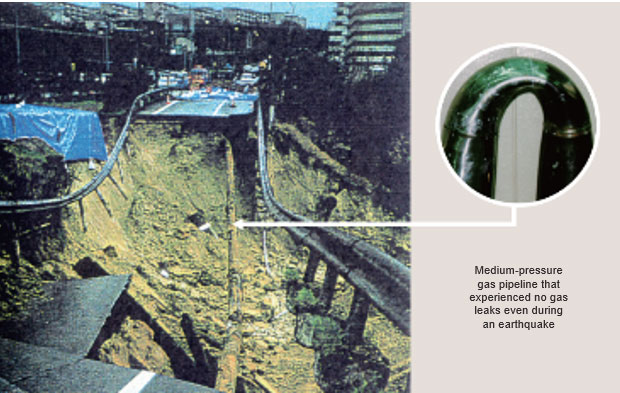
Medium-pressure gas pipeline that experienced no gas leaks even during an earthquake
Source: Report of the Gas Earthquake Countermeasures Study Committee (1996), Agency for Natural Resources and Energy
■ Toward Net-Zero CO2 Emissions across the Entire District
Even after the start of electricity and heat supply, the Project will continue to improve energy efficiency further while introducing new technologies and implementing various initiatives, including the adoption of methanation as the technology advances and the use of hydrogen in power generation, including hydrogen co-firing in the CGS units. By making use of existing energy infrastructure while progressively transitioning to low-carbon and carbon-free energy sources, the Project will drive decarbonization across the entire district, lead efforts to achieve the net-zero CO2 emissions target set by Mitsui Fudosan and the TEPCO Group, and advance efforts toward achieving carbon neutrality by 2050.
■ Energy Center Tour Programs
Although energy infrastructure is generally out of public view, it supports safe, secure, and comfortable living in communities 24 hours a day, 365 days a year. The Project will shine a light on the social role and value of this energy infrastructure and communicate its importance to a wider audience.
The facility plans to offer tour programs and other experiences using virtual reality (VR) and other digital content technologies so that visitors can intuitively experience the unseen value of energy, including how it flows, how the equipment works, and the role of energy infrastructure during disasters.
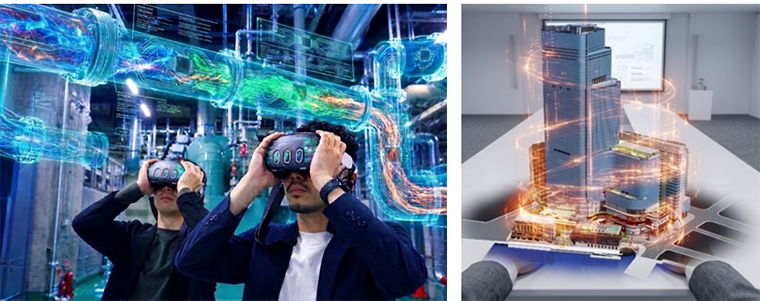
Conceptual images of a tour program using VR and other technologies
* These conceptual images were created using generative AI to illustrate the tour program. They differ from the actual facilities, experiences, and display screens.
■ Overview of Nihonbashi 1-chome Energy Center
| Completion date | September 30, 2026 |
|---|---|
| Start of supply | October 1, 2026 |
| Installation location | Within the buildings of the Nihonbashi 1-Chome Central District Category 1 Urban Redevelopment Project |
| Energy supply area | Approx. 409,028 ft2 (approx. 38,000 m2) |
| Total floor area of the energy supply area | Approx. 5,145,149 ft2 (approx. 478,000 m2) |
| Supply capacity | Electricity: approx. 24,000 kW / Cooling: approx. 125 GJ/h / Heating: approx. 97 GJ/h |
| Main equipment | Large-scale CGS units (7,800 kW × 2), centrifugal chillers, heat recovery chillers, waste heat-driven steam absorption chillers, thermal storage tanks, steam boilers, etc. |
■Company Overview of Mitsui Fudosan TEPCO Energy Co., Ltd.
| Company name | Mitsui Fudosan TEPCO Energy Co., Ltd. |
|---|---|
| Location | Head office: 3-2-1 Nihonbashi-Muromachi, Chuo-ku, Tokyo |
| Established | April 2023 |
| Capital | ¥100 million |
| Representative | Hiroyasu Nakade, President and Representative Director |
| Shareholders | Mitsui Fudosan Co., Ltd., TEPCO Energy Partner, Inc. |
■Overview of Tokyo Midtown Nihonbashi
| Project name | Nihonbashi 1-Chome Central District Category 1 Urban Redevelopment Project | ||
|---|---|---|---|
| Project manager | Nihonbashi 1-Chome Central District Urban Redevelopment Association | ||
| Location | Zone A: 1-9-1 Nihonbashi, Chuo-ku, Tokyo Zone B: 1-9-2 Nihonbashi, Chuo-ku, Tokyo Zone C: 1-5-1 Nihonbashi, Chuo-ku, Tokyo | ||
| District area | Approx. 7 acres (approx. 3.0 hectares) | ||
| Zone A | Zone B | Zone C | |
| Site area | Approx. 14,746 ft2 (approx. 1,370 m2) | Approx. 22,173 ft2 (approx. 2,060 m2) | Approx. 167,486 ft2 (approx. 15,560 m2) |
| Total floor area | Approx. 57,048 ft2 (approx. 5,300 m2) | Approx. 71,041 ft2 (approx. 6,600 m2) | Approx. 4,034,313 ft2 (approx. 374,800 m2) |
| Residential and retail use | Business facilities, retail facilities | Residences, retail facilities | Offices, retail facilities, hotel, rental residences, MICE facilities, business support facilities, parking lots, etc. |
| Number of floors/Max. height | 4 floors above ground, 2 floors below ground Approx. 108 ft (approx. 33 m) | 7 floors above ground, 2 floors below ground Approx. 104 ft (approx. 32 m) | 52 floors above ground, 5 floors below ground, 3 penthouse floors Approx. 931 ft (approx. 284 m) |
| Architect/Builder | Urban planning / business consultant / basic design / execution / management: Nikken Sekkei Ltd. Zone B: Design architect: Nikken Sekkei Ltd., Jun Mitsui & Associates Inc. Architects Zone C: Design architect: Nikken Sekkei Ltd., Pelli Clarke & Partners Inc. Contractor: Joint venture construction consortium for the Nihonbashi 1-Chome Central District Category 1 Urban Redevelopment Project | ||
| Access | Direct access from Tokyo Metro Ginza Line Nihombashi Station, Tokyo Metro Tozai Line Nihombashi Station, and Toei Asakusa Line Nihombashi Station A three-minute walk from Tokyo Metro Hanzomon Line Mitsukoshimae Station and an eight-minute walk from JR Tokyo Station | ||
| Overall completion | Completed on September 30, 2026 | ||
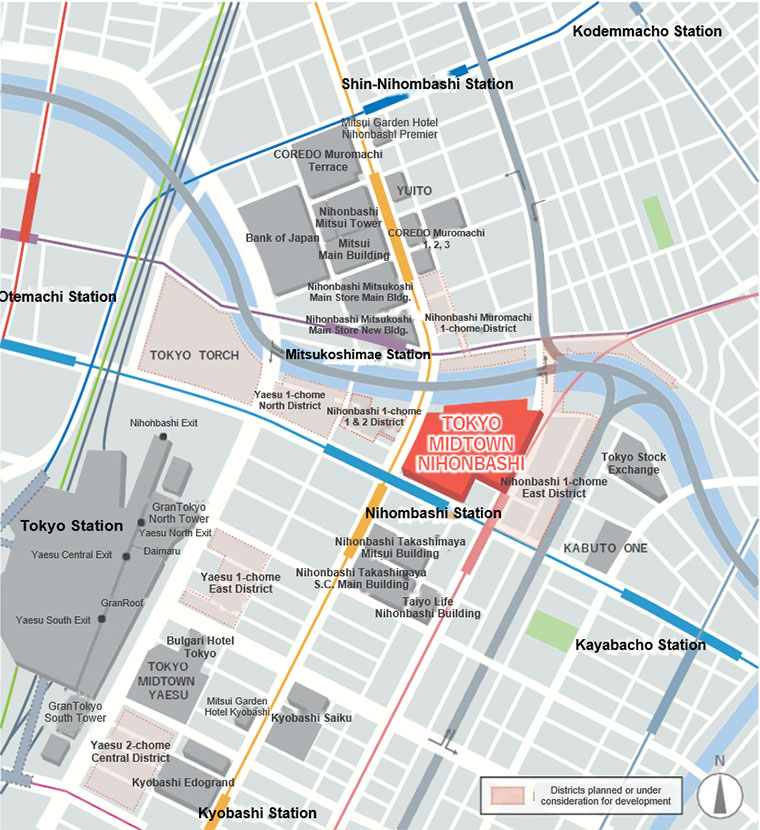
[Location Map]
■Contributing to the Realization of a Carbon-Neutral Society by the TEPCO Group
The TEPCO Group is committed to reducing CO₂ emissions associated with the electricity it supplies to customers by 50% by FY2030 compared to FY2013 levels, and to achieving net-zero CO₂ emissions from its energy supply by 2050.
Through the provision of a diverse range of renewable energy solutions, TEPCO EP helps customers address a wide range of challenges associated with renewable energy utilization, including compliance with environmental and decarbonization-related regulations and securing a stable power supply. By doing so, TEPCO EP will continue to work together with its customers to contribute to the realization of a carbon-neutral society.
■Sustainability in the Mitsui Fudosan Group
Based on the meaning of its “& mark,” “to generate new value with society through cooperation, coexistence and co-creation, we forge ahead, innovating,” the Mitsui Fudosan Group views the “creation of social value” and the “creation of economic value” as two wheels of a cart. Accordingly, we believe that the creation of social value leads to the creation of economic value, and that this economic value then creates even greater social value.
Moreover, we identified six Group Materiality priority issues when formulating our new management philosophy in April 2024. These Group Materiality priority issues are (1) Contribute to industrial competitiveness, (2) Coexist with the environment, (3) Health and Vitality, (4) Safety and security, (5) Diversity and inclusion, and (6) Compliance and governance. The Mitsui Fudosan Group will work to address each of the materialities through its core business activities and contribute to the promotion of sustainability.
(References)
・ Group Management Philosophy and Long-Term Vision
https://www.mitsuifudosan.co.jp/english/corporate/innovation2030/
・ Group Materiality
https://www.mitsuifudosan.co.jp/english/esg_csr/approach/materiality/