


























Mitsui Fudosan × SHIN NIPPON BIOMEDICAL LABORATORIES × Japan New Energy
Entering a New Demonstration Phase Aimed at Achieving Japan’s First Commercialization of Next-Generation Geothermal Power
—Coaxial Double-Pipe Closed-Loop System Drilled to Expand Geothermal Use—
October 14, 2026
Mitsui Fudosan Co., Ltd.
SHIN NIPPON BIOMEDICAL LABORATORIES, LTD.
Japan New Energy Co., Ltd.
Key Points of this Press Release
- Mitsui Fudosan, SHIN NIPPON BIOMEDICAL LABORATORIES, and Japan New Energy have jointly succeeded in drilling for a demonstration of next-generation geothermal power generation and have fully launched a demonstration test aimed at achieving the first commercialization of this technology in Japan.
- This next-generation geothermal power generation technology circulates water inside a double pipe installed in a single well and recovers heat without extracting hot water, steam, or associated substances from the ground. It aims to expand the potential for geothermal resource use while minimizing environmental impact above and below ground.
- The companies will verify the technology’s technical and economic feasibility through the demonstration and explore a community-based business model that revitalizes local industries and creates new economic cycles, with an eye to collaboration with other companies and organizations and future expansion to other regions.
Tokyo, Japan, October 14, 2026 - Mitsui Fudosan Co., Ltd., a leading global real estate company headquartered in Tokyo, SHIN NIPPON BIOMEDICAL LABORATORIES, LTD. (hereafter, “SNBL”), and Japan New Energy Co., Ltd. (hereafter, “JNEC”) announced today that they are jointly conducting a demonstration test (hereafter, “the Demonstration Test”) aimed at commercializing the coaxial double-pipe closed-loop system (hereafter, “the Closed-Loop System”),*1 a next-generation geothermal power generation technology developed by Mitsui Fudosan and JNEC.
The Closed-Loop System generates power from geothermal heat by circulating water inside a double pipe installed deep underground, rather than extracting hot water or steam from underground. As it is less dependent on natural hot water, steam, or geological structures, it is anticipated to serve as a next-generation technology that expands the potential of geothermal energy use.
Mitsui Fudosan, SNBL, and JNEC have now completed the drilling required for the Demonstration Test in Ibusuki City, Kagoshima Prefecture, and confirmed the potential for power generation using the Closed-Loop System. They will next build and operate a demonstration plant to verify technical and economic feasibility with a view to commercialization.
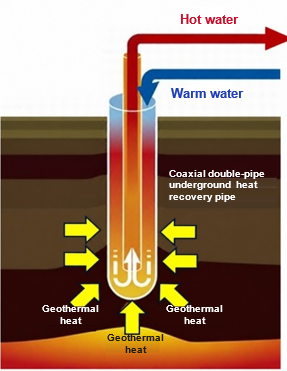
Closed-Loop System concept diagram
The companies will also draw on the knowledge gained from the Demonstration Test to broadly explore collaboration with companies and organizations in fields such as technology, construction, and electricity use, as well as candidate sites for future projects, to further expand geothermal resource use. In addition to utilizing geothermal resources in regions where geothermal power generation has been difficult, they aim to establish a community-based business model that revitalizes local industries and creates new economic cycles, with an eye to collaboration with neighborhood creation and related businesses that leverage regional characteristics.
How Geothermal Power Generation Works and Features of the Closed-Loop System
Geothermal power generation is a form of renewable energy that generates electricity using thermal energy from underground. Because it is less affected by weather or time of day, it is expected to serve as a stable source of power.
< Table 1 Comparison of Geothermal Power Generation Technologies >
| Conventional geothermal power generation | The Closed-Loop System | |
|---|---|---|
| Method/Features |
|
|
| Conditions |
|
|
| Concept diagram |
 * Created using generative AI |
|
[Conventional Geothermal Power Generation]
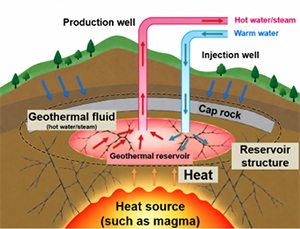
Conventional geothermal power generation extracts hot water or steam from underground to the surface for use in power generation and has been used in Japan and overseas for many years. For this method, it is essential that the following three natural conditions be present:
- Sufficient heat continuously supplied from an underground heat source (such as magma) through the surrounding strata
- Natural geothermal fluid (hot water or steam) that carries the heat to the surface
- A researvoir structure that stores hot water or steam underground (a geological structure that has features such as a geothermal reservoir*2, fractures such as faults, and an impermeable cap rock*3)
Geothermal resources exist deep underground, and their location and scale cannot be confirmed directly from the surface. Development therefore proceeds in stages—surface surveys, exploratory drilling, and flow tests—to confirm the subsurface conditions and whether sufficient and stable hot water or steam for power generation can be obtained.
However, there are limits to how fully subsurface conditions can be understood through preliminary surveys alone. Even as surveys and drilling proceed, the expected geothermal reservoir may not be found, or even if it is found, the resource volume required for power generation may not be secured and the project may not reach commercialization. Against this backdrop, there are high expectations for next-generation geothermal power generation technologies that reduce the uncertainty inherent in underground resources and expand the range of areas where development is feasible.
[The Closed-Loop System]
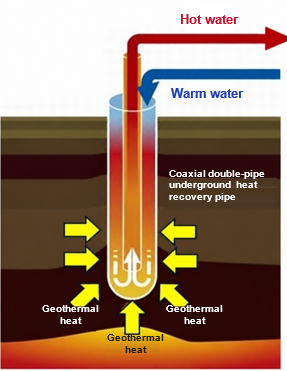
As a new approach to expanding the potential of geothermal energy use, the Closed-Loop System is a next-generation geothermal power generation technology that, rather than extracting hot water or steam from underground, circulates water inside a sealed pipe consisting of an inner pipe and an outer pipe installed in a single well (a coaxial double-pipe heat recovery pipe; see the conceptual diagram in Table 1), heats the water in the pipe through underground heat, and uses that thermal energy for power generation.
Its major technical feature is that it uses underground heat through an artificial water circulation system installed in the ground, rather than pumping up hot water or steam itself from underground. Because hot water, steam, and associated substances are not brought from underground to the surface, the system is expected to enable the use of geothermal resources while minimizing environmental impact above and below ground.
Furthermore, because the system reduces dependence on natural conditions such as naturally occurring hot water and steam and geological structures, it is expected to expand the potential for geothermal energy use to regions that have sufficient underground heat but have lacked the conditions needed for geothermal power generation, as well as to regions where development was considered difficult.
Toward the Social Implementation of Next-Generation Geothermal Power Generation
Mitsui Fudosan formulated its Group Action Plan to Realize Decarbonized Society in November 2021, and in its new Group long-term vision, & INNOVATION 2030, announced in April 2024, it also clearly states that it will promote sustainability management that actively contributes to a sustainable society. As an industrial developer taking on the challenge of realizing a decarbonized society, Mitsui Fudosan will advance a diverse range of renewable energy businesses. At the same time, rather than treating the Closed-Loop System merely as a power generation technology, it will also contribute to the stable use of renewable energy rooted in local communities, sustainable neighborhood creation, and the revitalization of local industries, and work to create a new industrial base. Going forward, Mitsui Fudosan will accelerate its efforts toward the early social implementation of next-generation geothermal power generation while deepening collaboration with diverse partners in industry, academia, government, and local communities.
Mitsui Fudosan has also been selected to carry out engineering and other work related to the Closed-Loop System for the feasibility study on next-generation geothermal power generation projects (fourth public call)*4 solicited by the Japan Organization for Metals and Energy Security (JOGMEC), an incorporated administrative agency under the jurisdiction of the Ministry of Economy, Trade and Industry, and is currently engaged in this work.
- 1 Next-generation geothermal power generation technology (coaxial double-pipe closed loop):
A method that circulates water inside a sealed pipe installed deep underground, recovers geothermal energy without bringing hot water, steam, or associated substances from underground to the surface, and uses that heat for power generation - 2 Geothermal reservoir:
An area where high-temperature hot water or steam is stored, such as in fractures in underground bedrock - 3 Cap rock:
An impermeable stratum or bedrock that prevents underground hot water or steam from escaping upward and serves as a “lid” over the geothermal reservoir - 4 Feasibility study on next-generation geothermal power generation projects (fourth public call):
A study conducted to provide support for technological development in next-generation geothermal power generation technology, such as measures to reduce initial risks associated with technology demonstrations and cost reduction
* The details of the demonstration and future plans described in this press release are current plans and are subject to change depending on the results of future verification and other factors.
■ About SHIN NIPPON BIOMEDICAL LABORATORIES, LTD.
SHIN NIPPON BIOMEDICAL LABORATORIES, LTD. (SNBL), founded in 1957, is a contract research organization (CRO) that supports pharmaceutical development. It contributes to people’s health and the advancement of medicine while aiming to realize a sustainable society. It also operates its Translational Research Business and Medipolis Business to create new value. In its Medipolis Business, SNBL owns Medipolis Ibusuki, an expansive site located on high ground in Ibusuki City, Kagoshima Prefecture, where it operates a Power Generation Business and Hospitality Business that leverage this natural capital. In its Power Generation Business, SNBL has operated a geothermal power plant since 2015, and in fiscal 2025 it generated approximately 14 million kWh, including output from its hot spring power plant.
■ About Japan New Energy Co., Ltd.
Japan New Energy Co., Ltd. is an energy company engaged in the research, development, and commercialization of a new coaxial geothermal power generation system. The company is developing a new closed-loop geothermal power generation technology that utilizes underground heat, with the aim of promoting the spread of renewable energy and bringing energy closer to local communities.
■ Sustainability in the Mitsui Fudosan Group
Based on the meaning of its “& mark,” “to generate new value with society through cooperation, coexistence and co-creation, we forge ahead, innovating,” the Mitsui Fudosan Group views the “creation of social value” and the “creation of economic value” as two wheels of a cart. Accordingly, we believe that the creation of social value leads to the creation of economic value, and that this economic value then creates even greater social value.
Moreover, we identified six Group Materiality priority issues when formulating our new management philosophy in April 2024. These Group Materiality priority issues are (1) Contribute to industrial competitiveness, (2) Coexist with the environment, (3) Health and Vitality, (4) Safety and security, (5) Diversity and inclusion, and (6) Compliance and governance. The Mitsui Fudosan Group will work to address each of the materialities through its core business activities and contribute to the promotion of sustainability.
(References)
・ Group Management Philosophy and Long-Term Vision
https://www.mitsuifudosan.co.jp/english/corporate/innovation2030/
・ Group Materiality
https://www.mitsuifudosan.co.jp/english/esg_csr/approach/materiality/