


























Mitsui Fudosan × KDDI SmartDrone
Demonstration of Office Building Facility Inspections Using a Drone Designed for Confined Spaces
Aiming to Improve Safety and Work Efficiency in Inspections of Confined, Dark, and Elevated Spaces
June 2, 2026
Mitsui Fudosan Co., Ltd.
KDDI SmartDrone Inc.
Key Points of this Press Release
- Conducted a demonstration of facility inspections using IBIS2, a drone designed for confined spaces, at Iidabashi Grand Bloom, an office building managed by Mitsui Fudosan.
- Confirmed that, in confined, dark, and elevated spaces, the drone can improve safety and work efficiency and conduct inspections with clear video footage, all while reducing the need for workers to enter such areas.
- Aiming to move toward practical use in office buildings while expanding target facilities and sites, further advancing facility management.
Tokyo, Japan, June 2, 2026 - Mitsui Fudosan Co., Ltd., a leading global real estate company headquartered in Tokyo (hereafter, “Mitsui Fudosan”), and KDDI SmartDrone Inc., headquartered in Tokyo (hereafter, “KDDI SmartDrone”), announced today that they have conducted a demonstration of facility inspections using IBIS2, a drone designed for confined spaces, at Iidabashi Grand Bloom, an office building managed by Mitsui Fudosan (hereafter, “the demonstration”).
In facility inspection work for office building management, securing worker safety and reducing the heavy burden on on-site workers are ongoing challenges—whether in elevated work that requires setting up stepladders or temporary scaffolding, such as above ceilings, or in work in confined, dark spaces, such as inside ducts and underground water tanks. Against this backdrop, the demonstration was conducted to verify whether using a drone specialized for confined spaces to check facility conditions in confined, dark, and elevated spaces could help shorten work times, improve safety, and maintain and enhance inspection quality.
In 2025, Mitsui Fudosan and KDDI SmartDrone installed a drone equipped with an automatic charging port on the rooftop of a high-rise building managed by Mitsui Fudosan and conducted a demonstration simulating information gathering in the event of a disaster. This latest demonstration extends these efforts to use drones in urban buildings beyond aerial information gathering during disasters into the realm of routine building maintenance.
Video of the confined-space inspection demonstration using IBIS2: https://youtu.be/v35GlgUqPUU (in Japanese)
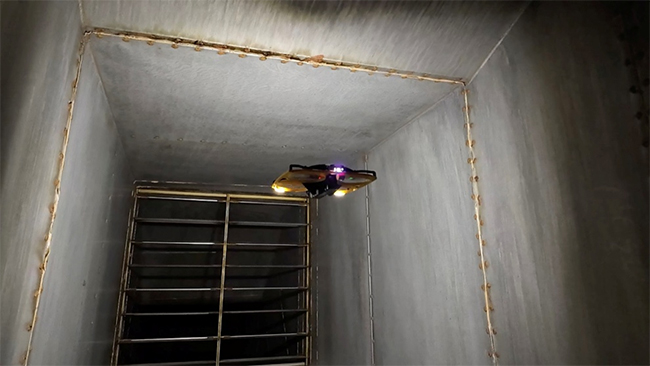
IBIS2 in flight inside a duct
■ Demonstration Overview
| Location | Iidabashi Grand Bloom (2-chome Fujimi, Chiyoda-ku, Tokyo) |
|---|---|
| Drone used | IBIS2, a drone designed for confined spaces (manufactured by Liberaware)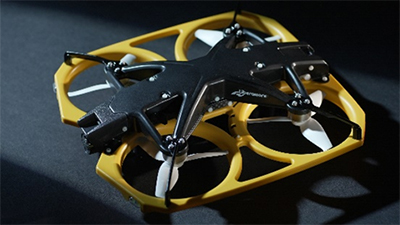
|
| Verification details | Verification of whether drone flight and filming are feasible in confined, dark, and elevated spaces, such as inside underground water tanks and air-conditioning ducts, above ceilings, and in high-voltage electrical rooms, as well as whether the drone improves work efficiency and safety |
Flight footage
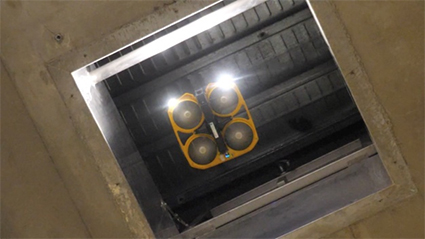
Entering a ceiling space
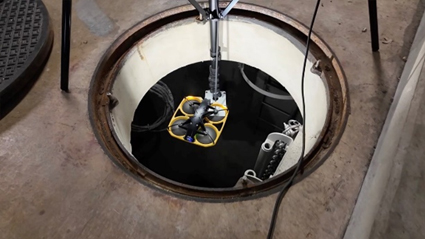
Entering a manhole
Captured images
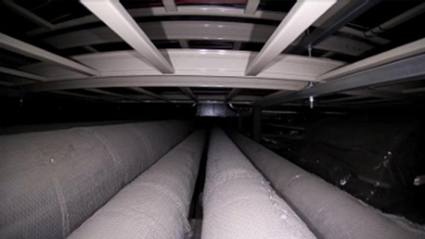
Heat source machine room
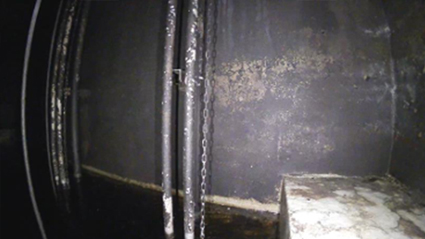
Reclaimed water treatment machine room
■ Demonstration Results
IBIS2 conducted flights and filming in the targeted confined, dark, and elevated inspection sites and confirmed the following outcomes:
(1) Visualizing Facility Conditions in Hard-to-Inspect Locations
In hard-to-inspect locations, such as duct systems and underground water tanks where it is difficult for workers to enter or make visual checks, IBIS2 carried out flights and filming to capture footage of water leaks, dirt, damage, and other issues. This demonstrated the potential to visualize the internal condition of facilities safely and efficiently, even in environments where ordinary visual inspection is difficult, such as in dark or dusty environments. In underground water tanks in particular, checking the interior previously required workers to reduce the water level, take safety precautions, and then enter the tank through a manhole, all of which demanded extensive preparation and placed a heavy burden on the workers. The demonstration confirmed the potential ability to check facility conditions using drone footage even in the interiors of facilities that are difficult for people to enter directly.
(2) Improving Worker Safety by Replacing and Supplementing Hazardous Work
In locations that previously required workers to perform elevated work or enter confined or enclosed spaces, the demonstration confirmed that facility conditions could be checked using footage captured by IBIS2. This confirmed the potential to reduce the risk of falls associated with work using stepladders and temporary scaffolding, as well as the physical burden of entering underground water tanks and similar spaces, thereby helping to ensure worker safety.
(3) Improving Inspection Efficiency by Reducing Incidental Work
The demonstration confirmed the potential to reduce some of the incidental work that arises outside of the inspection itself, such as installing temporary scaffolding and stepladders for inspections and draining water and other advance preparations for checking inside tanks. By using a drone to capture footage remotely, the demonstration confirmed that preparations for accessing inspection sites could be simplified, helping to shorten work hours and improve efficiency in inspection operations.
■ Future Plans
Based on the insights gained from the demonstration, Mitsui Fudosan and KDDI SmartDrone will examine the feasibility of implementing drone-based facility inspection work in office buildings. Going forward, they will expand the range of target facilities, advance inspection methods, and make use of the data obtained with the aim of further improving the safety and efficiency of facility management operations. In addition, by broadening the range of drone applications in urban buildings, from routine maintenance and inspection in normal times to assessing damage in emergencies, they will contribute to the digital transformation (DX) of urban infrastructure maintenance and management, as well as provide greater disaster resilience.
■ About Mitsui Fudosan Co., Ltd.
Based in Nihonbashi, Mitsui Fudosan promotes neighborhood creation under the concept of “Retaining, Reviving, Creating.” In strategic fields such as life science, aerospace, semiconductors, mobility, and food, the company generates new businesses and culture, and through co-creation with a wide range of players, it contributes to the realization of a sustainable society.
■ About KDDI SmartDrone Inc.
KDDI SmartDrone is developing services that enable safe remote and long-distance drone flights by controlling drones using aerial radio signals (4G LTE). The company is working to create new drone-based businesses and provide agile services tailored to customer needs across a wide range of fields, including inspection, monitoring, surveying, logistics, and agriculture.
The company also operates KDDI SmartDrone Academy, a drone school running at more than 20 locations across Japan that offers unmanned aircraft pilot certification courses corresponding to the national drone qualifications, as well as specialized courses focused on specific solution areas.
For company information, please visit https://kddi.smartdrone.co.jp/ (in Japanese).