


























Ise-Shima to Anchor a New “Regional Air Mobility Route Network” Concept
Mitsui Fudosan Group to Connect Tourism Destinations across the Chubu and Kansai Regions Using Advanced Air Mobility
Selected for Mie Prefecture’s Program to Assess Demand and Infrastructure toward Commercial Operation
August 3, 2026
Mitsui Fudosan Co., Ltd.
Ise-Shima Resort Management Co., Ltd.
Key Points of this Press Release
- A project jointly proposed by Mitsui Fudosan and Ise-Shima Resort Management has been selected for Mie Prefecture’s publicly solicited “Feasibility Study toward the Future Commercial Operation of Advanced Air Mobility.”
- Envisioning a wide-area air mobility network across the Chubu and Kansai regions centered on Ise-Shima, the project will assess passenger demand for tourism and other purposes, along with the feasibility of implementing flight routes, takeoff and landing sites, and related infrastructure. It is being advanced in collaboration with Kintetsu Group Holdings, Aero Toyota, Skyports, Chubu Electric Power Miraiz, Toyota Motor, and Central Japan International Airport.
Tokyo, Japan, August 3, 2026 - Mitsui Fudosan Co., Ltd., a leading global real estate company headquartered in Tokyo, and Ise-Shima Resort Management Co., Ltd., a Mitsui Fudosan Group company that operates NEMU RESORT and other facilities, announced today that their joint proposal, submitted together with partner and cooperating companies, has been selected under Mie Prefecture’s subsidy program for feasibility studies on future commercial advanced air mobility operations. The selected project, titled “Feasibility Study on Demand and Implementation for a Wide-Area Air Mobility Network Spanning the Chubu and Kansai Regions, Centered on Ise-Shima,” will assess passenger demand and the feasibility of implementing flight route, vertiport, and related infrastructure.
To support the practical realization of advanced air mobility in Japan, the Mitsui Fudosan Group has been studying the development and operation of takeoff and landing sites (vertiports) in specific projects such as the Tsukiji District development project and initiatives in the Ise-Shima region of Mie Prefecture. This project takes those efforts a step further, positioning advanced air mobility as social infrastructure that can serve as a “new tourism experiences,” a means of “improving regional connectivity,” and an “emergency response and disaster relief network in times of disaster.” Centered on Ise-Shima, it will assess demand across the wider Chubu and Kansai regions along with the feasibility of implementing flight routes and infrastructure.
Specifically, this project positions the Ise-Shima region as a hub of a wide-area tourism network spanning Chubu and Kansai. Drawing on demand from the Aichi/Chubu and Osaka/Kansai regions, it will explore the potential for wide-area tour routes and travel products that link tourism assets such as Ise-Shima, the Kumano Kodo Pilgrimage Route, Koyasan, and Nara. Looking ahead to future commercial operations, the project will conduct demand surveys, evaluate multiple flight routes, and assess the feasibility of developing vertiports and related infrastructure.
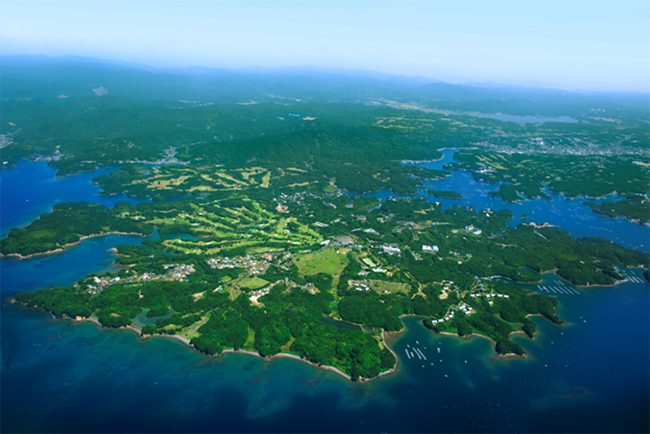
Ise-Shima region, Mie Prefecture
■Background and Objectives of the Project
Advanced air mobility is a new mode of transportation expected to prove useful across a wide range of settings, including urban areas, tourist destinations, districts with limited transportation access, and in disaster response. At the national level, the government is working on regulatory frameworks and concrete use cases through bodies such as the Public-Private Committee for Advanced Air Mobility, and efforts toward practical deployment have gained momentum in the wake of Expo 2025 Osaka, Kansai, Japan.
Mie Prefecture is home to a wealth of tourism assets that draw travelers from Japan and abroad, including Ise Jingu, Toba, Shima, and the Kumano Kodo Pilgrimage Route. At the same time, there is room to improve accessibility, including access to Ise-Shima from major metropolitan areas and international airports such as Nagoya/Chubu Centrair International Airport and Osaka/Kansai International Airport, and along the wider tour corridors extending from Ise-Shima to the Kumano Kodo Pilgrimage Route, Koyasan, Nara, and beyond.
Advanced air mobility is characterized by features such as electric propulsion and low noise. Beyond shortening travel times, it is expected to create new experiential value by enabling passengers to enjoy a region’s natural scenery from the sky. Its potential extends beyond boosting tourism demand. As local social infrastructure, it can improve the accessibility of regional transportation and support emergencies and relief networks in times of disaster.
Against this backdrop, the Mitsui Fudosan Group positions Ise-Shima as the hub of a wide-area tourism network spanning the Chubu and Kansai regions, and will assess the feasibility of implementing new tourism, transportation, and disaster preparedness and response models built around advanced air mobility.
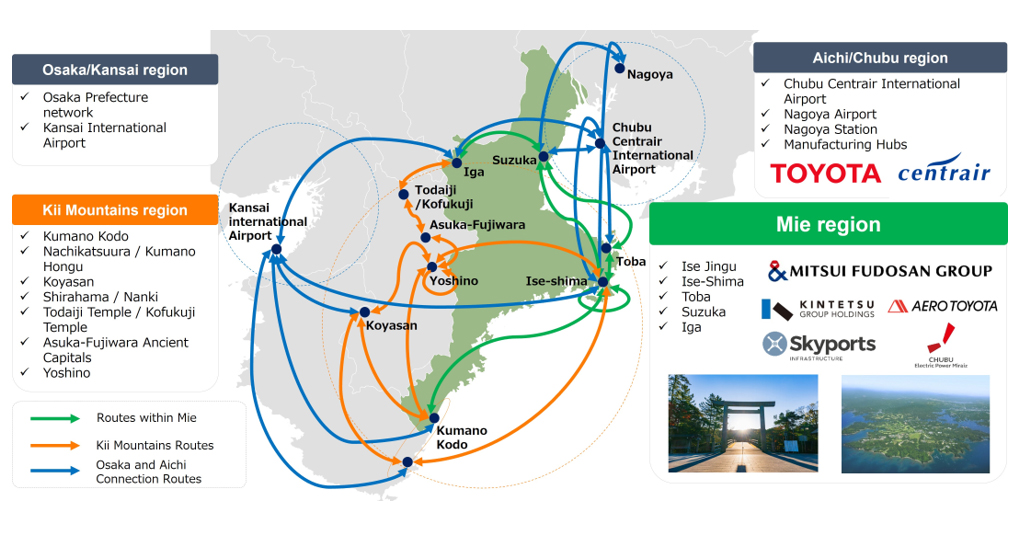
Conceptual diagram of the wide-area Chubu and Kansai advanced air mobility network centered on Ise-Shima
Click illustration to enlarge
■Key Features of the Project
- Envisioning an advanced air mobility network and infrastructure across the wider Chubu and Kansai regions, centered on Ise-Shima
The project positions Ise-Shima as the hub of a wide-area network that captures demand from the Aichi/Chubu and Osaka/Kansai regions. It will also develop a long-term vision that integrates flight routes, vertiports, and supporting infrastructure, linking multiple tourism areas across the Kii Mountains, including Ise-Shima and the Kumano Kodo Pilgrimage Route. - Surveying demand for new tourism products and travel experiences, with a focus on high-value travelers
The project will explore the potential for new tourism products that combine the travel value offered by advanced air mobility with the tourism assets of Ise-Shima and its surroundings, including nature, cuisine, history and culture, and resort stays. Demand will be surveyed with a focus on high-value travelers, defined as those who spend ¥1 million or more per person at the destination. - Assessing the feasibility of multiple flight routes, vertiports, power infrastructure, and integration with existing mobility networks
For each anticipated flight route, the project will identify and assess candidate vertiport locations, power infrastructure such as charging facilities, connections to existing transportation, and operational challenges. The study will identify the requirements for future deployment, including coordination with existing ground mobility (such as rail, buses, and taxis), marine mobility (such as yachts), airports, and lodging and tourism facilities. - Boosting tourism demand, with a view to improved transportation accessibility and disaster preparedness
Under normal conditions, the project aims to encourage tourism to Ise-Shima and other areas as well as to promote wide-area touring, thereby increasing length of stay and tourism spending. Looking ahead, it will also examine applications such as improving inter-regional travel and supporting emergency response, the transport of emergency supplies, and support for isolated communities in times of disaster.
■Project Structure
| Company name | Category | Role |
|---|---|---|
| Mitsui Fudosan | Lead applicant |
|
| Ise-Shima Resort Management | Co-applicant (Mitsui Fudosan Group) |
|
| Kintetsu Group Holdings Co., Ltd. | Partner company |
|
| Aero Toyota Corporation | Partner company |
|
| Skyports Limited | Partner company |
|
| Chubu Electric Power Miraiz Co., Inc. | Partner company |
|
| Toyota Motor Corporation | Cooperating company |
|
| Central Japan International Airport Co., Ltd. | Cooperating company |
|
■Company Profiles
Mitsui Fudosan Co., Ltd.
| Location | 2-1-1 Nihonbashi-Muromachi, Chuo-ku, Tokyo |
|---|---|
| Representative | Takashi Ueda, Representative President and Chief Executive Officer |
| Lines of business | Real estate operations including office buildings, retail facilities, hotels and resorts, housing, logistics facilities, and urban development |
Ise-Shima Resort Management Co., Ltd.
| Location | 2692-3 Hazako, Hamajima Town, Shima City, Mie Prefecture |
|---|---|
| Representative | Kosuke Sagara, Representative Director and President |
| Lines of business | Operation of the Toba International Hotel, Shioji-tei, NEMU RESORT, and other facilities |
Kintetsu Group Holdings Co., Ltd.
| Location | 6-1-55 Uehommachi, Tennoji-ku, Osaka |
|---|---|
| Representative | Takashi Wakai, Representative Director and President |
| Lines of business | Transportation, real estate, international logistics, merchandise sales, and hotel and leisure, among others |
Aero Toyota Corporation
| Location | 4-7-41 Shinkiba, Koto-ku, Tokyo |
|---|---|
| Representative | Kazuyuki Kakisako, President |
| Lines of business | Aviation and geospatial information services, among others |
Skyports Limited
| Location | Edinburgh House, 170 Kennington Lane, London, SE11 5DP, UK |
|---|---|
| Representative | Duncan Walker, CEO |
| Lines of business | Development and operation of vertiports for air mobility, among others |
Chubu Electric Power Miraiz Co., Inc.
| Location | 1 Higashi-shin Cho, Higashi-ku, Nagoya City, Aichi Prefecture |
|---|---|
| Representative | Osamu Nakagawa, Representative Director, President and Executive Officer |
| Lines of business | Electricity and gas operations, among others |
Toyota Motor Corporation
| Location | 1 Toyota Cho, Toyota City, Aichi Prefecture |
|---|---|
| Representative | Kenta Kon, President, Member of the Board of Directors (Representative Director) |
| Lines of business | Motor vehicle production and sales, among others |
Central Japan International Airport Co., Ltd.
| Location | 1-1 Centrair, Tokoname City, Aichi Prefecture |
|---|---|
| Representative | Hironori Kagohashi, President and CEO |
| Lines of business | Establishment and administration of Chubu Centrair International Airport and air safety facilities, among others |
■ Examples of Mitsui Fudosan’s Vertiport Study Projects
Drawing on its broad portfolio of assets, Mitsui Fudosan envisions a network in which advanced air mobility can deliver new value and is advancing studies on vertiport development and operation. In this project, starting from the Ise-Shima region, it will verify a wide-area, network-based deployment model that generates combined value across tourism, transportation, and disaster preparedness, and will apply the resulting expertise to other areas in Japan.
| Projects under study | Tsukiji District Development Project | Ise-Shima region, Mie Prefecture (e.g., NEMU RESORT) |
|---|---|---|
 © Tsukiji Machizukuri Co., Ltd. Image as of August 2025. Subject to change. |
 |
|
| Location | Within Tsukiji 5-chome and Tsukiji 6-chome, Chuo-ku, Tokyo | Hazako, Hamajima Town, Shima City, Mie Prefecture |
| Uses | A total of nine buildings, including grand scale multifunctional venue, a life science and commercial complex, a MICE/hotel/residence building, and a boat transport and theater hall complex | Resort hotels, golf courses, and other facilities |
| Anticipated timing | Phase 1 opening: First half of the 2030s or later | Late 2020s |
* The anticipated timing is subject to change in light of laws and ordinances, the planning status, market trends, technological developments, and other factors.
■ Sustainability in the Mitsui Fudosan Group
Based on the meaning of its “& mark,” “to generate new value with society through cooperation, coexistence and co-creation, we forge ahead, innovating,” the Mitsui Fudosan Group views the “creation of social value” and the “creation of economic value” as two wheels of a cart. Accordingly, we believe that the creation of social value leads to the creation of economic value, and that this economic value then creates even greater social value.
Moreover, we identified six Group Materiality priority issues when formulating our new management philosophy in April 2024. These Group Materiality priority issues are (1) Contribute to industrial competitiveness, (2) Coexist with the environment, (3) Health and Vitality, (4) Safety and security, (5) Diversity and inclusion, and (6) Compliance and governance. The Mitsui Fudosan Group will work to address each of the materialities through its core business activities and contribute to the promotion of sustainability.
(References)
・ Group Management Philosophy and Long-Term Vision
https://www.mitsuifudosan.co.jp/english/corporate/innovation2030/
・ Group Materiality
https://www.mitsuifudosan.co.jp/english/esg_csr/approach/materiality/