Even in a world of positive interest rates, we will
accelerate the virtuous cycle of growth, efficiency,
and shareholder returns to achieve sustainable
EPS growth and a higher share price.
Chiharu Fujioka
Senior Executive Managing Officer

Fiscal 2025 Business Results and Future Outlook
In 2024, in my role as CFO, I was involved in deliberations and the formulation of the Group’s long-term vision “& INNOVATION 2030.” Under this long-term vision, we set numerical targets for a variety of key indicators, including growth potential, efficiency, and shareholder returns for fiscal 2026, as milestones in the lead-up to our fiscal 2030 vision, in a bid to deepen interactive dialogue with investors and other stakeholders.
In fiscal 2025, the second year of the vision, revenue from operations, operating income, business income, a new profit indicator introduced under “& INNOVATION 2030,” ordinary income, and profit attributable to owners of parent (net income) exceeded forecasts coming in at record highs. Meanwhile, we achieved the profit and ROE targets set for fiscal 2026, the fiscal year ending March 31, 2027, identified under “& INNOVATION 2030” one year ahead of schedule.
In accordance with the Company’s efforts to bolster its “& INNOVATION 2030” shareholder returns policy and secure a total payout ratio of 50% or higher and a dividend payout ratio of around 35%, Mitsui Fudosan decided to repurchase ¥57 billion of its own shares. At the same time, the decision was also made to increase its annual dividend from the original forecast of ¥33 per share to ¥35 per share. As a result, the total payout ratio came in at 54.9% on net income of ¥278.6 billion.
Turning to forecasts for fiscal 2026, the Company has taken into account such factors as increases in office rents in Japan and overseas, leasing income growth on the back of higher sales at retail facilities in and outside Japan, and higher sales profit owing to the acceleration of asset turnover based on a holistic approach to the management of fixed assets and real estate for sale. On this basis, revenue from operations, operating income, business income, ordinary income, and net income are all projected to reach record highs. Business income is forecast at ¥450 billion, up ¥4.8 billion year on year, while net income is forecast at ¥285 billion, up ¥6.3 billion. Although profit growth is expected to be more moderate than in the previous fiscal year due to the “growing pains” associated with the completion of properties that will serve as seeds for future profit growth, our earning power is steadily strengthening through measures such as rent increases in the office business and higher retail facility sales driven by the drawing power of sports and entertainment.
As an indicator of growth potential, we have positioned the Company’s EPS growth rate as an important KPI that reflects the growth potential of net income, a source of shareholder returns, in terms of value per share. Under “& INNOVATION 2030,” we have identified a compound annual growth rate (CAGR) target of +8% or higher over the three-year period from fiscal 2024 to fiscal 2026 starting from an EPS of ¥78.5 based on the forecast net income of 220 billion for fiscal 2023. Against this target, EPS was ¥101.0 in fiscal 2025, resulting in a CAGR of 13.4% from the fiscal 2023 base.
Furthermore, based on forecast net income of ¥285 billion for fiscal 2026, EPS is projected to be approximately ¥105. Accordingly, the CAGR over the three years from fiscal 2024 to fiscal 2026 is expected to significantly exceed the target of +8% or higher per year.
While Group-wide energies are being directed toward achieving the business income and net income targets, together with the growth potential and efficiency indicators, such as the EPS growth rate and ROE, by realizing growth through the three business strategy paths identified under “& INNOVATION 2030,” as CFO, I will continue to support efforts aimed at achieving these targets, especially through financial management and the allocation of cash.
<Progress of & INNOVATION 2030 KPIs>
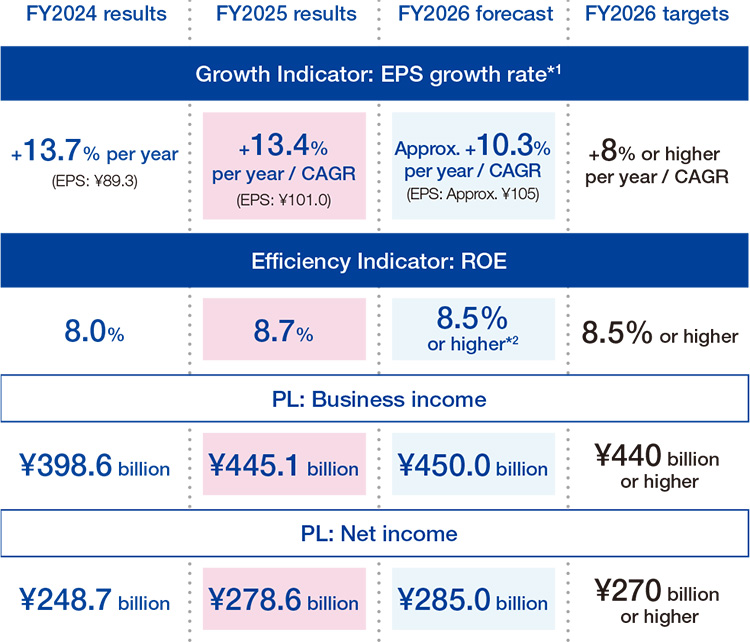
*1 Starting from the fiscal 2023 forecasted EPS: ¥78.5.
*2 Calculated based on certain assumptions.
Cash Allocation for Promoting Management with an Equal Focus on the Three Key Objectives: Enhance Growth, Efficiency, and Shareholder Returns
Mitsui Fudosan has put forward a cash allocation plan, covering the three-year period from fiscal 2024 to fiscal 2026, within its long-term vision “& INNOVATION 2030,” in order to help investors better understand its various activities, including how the Company generates cash, how that cash is applied, and our approach to financial management thereby deepening communication.
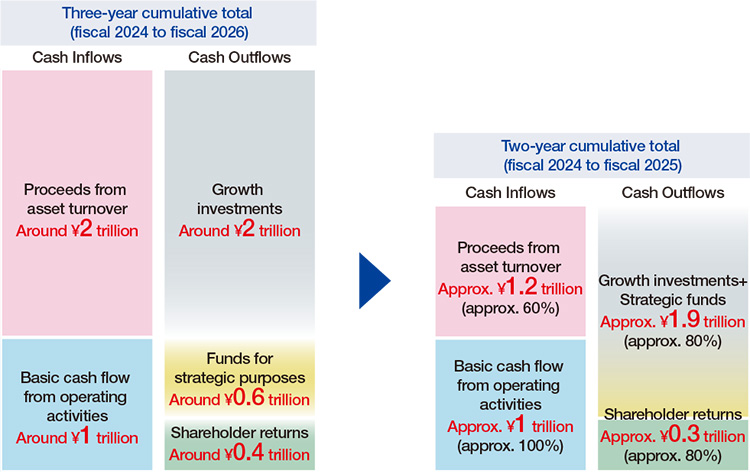
For the two-year period from fiscal 2024 to fiscal 2025, both cash in and cash out totaled approximately ¥2.2 trillion, representing roughly two-thirds of the plan and indicating steady progress.
Basic cash flow from operating activities
Mitsui Fudosan established “basic cash flow from operating activities” as a measure designed to more clearly show growth in the cash-generating capacity of its core businesses. Driven by factors including growth in operating income and business income across segments, basic cash flow from operating activities reached approximately ¥1 trillion over the two-year period, roughly the amount originally projected for the full three years.
Proceeds from asset turnover
In line with our policy of accelerating asset turnover, Mitsui Fudosan plans to recover approximately ¥2 trillion over the three years under “& INNOVATION 2030.” This is approximately 1.4 times the amount recovered from fiscal 2021 to fiscal 2023. Over the two years through fiscal 2025, in addition to real property for sale, we made progress in selling fixed assets and investment securities, bringing cumulative proceeds from asset turnover to approximately ¥1.2 trillion. This represents progress of approximately 60% against the plan, and we believe that the acceleration of asset turnover is proceeding steadily.
Cash out and capital allocation
Drawing from the roughly ¥2.2 trillion attributable to the Company’s basic cash flow from operating activities as well as proceeds from asset turnover, Mitsui Fudosan allocated capital to growth investments, strategic funds, and shareholder returns while controlling increases in outstanding debt over the two-year period from fiscal 2024 to fiscal 2025 in accordance with its policy identified when formulating its cash allocation plan. In other words, we achieved this allocation without relying on new borrowings or equity financing.
Turning to growth investments in particular, we are making steady progress, including the acquisition of prime investment properties that were not originally scheduled when formulating “& INNOVATION 2030.” Notable examples include large-scale retail facility development plans in Fuchu City, Tokyo, the rental lab and office buildings businesses’ “Innovation Square Phase III” project in Boston in the United States, the office buildings business’s “55 Pitt Street” project in the CBD area of Sydney, Australia, and the rental lab and office buildings businesses’ “British Library Redevelopment Project (tentative name)” in London in the United Kingdom. In addition, we have secured investment opportunities that optimally align with the use of strategic funds. This includes the acquisition of Toyota Automall Development Corporation (currently MF AUTOMALL DEVELOPMENT CORPORATION)* and the decision to enter into a capital and business alliance through the acquisition of shares in MITSUI-SOKO HOLDINGS Co., Ltd. Based on the aforementioned, the cumulative two-year total of growth investment and strategic funds came in at around ¥1.9 trillion.
Mitsui Fudosan will continue to carefully select and secure growth investment opportunities that help enhance corporate value over the medium to long term. We will also adhere strictly to a capital allocation policy that focuses on investment returns and capital efficiency. Moreover, I recognize that as CFO it is my responsibility to ensure the optimal allocation of capital taking into consideration a raft of factors, including the share price, share buybacks, and the level of investment return.
Moving forward, we will continue to disclose to investors the progress made in our management approach that places an equal focus on the three key objectives: enhance growth, efficiency, and shareholder returns, which is consistent with our understanding that “there can be no return without growth” and that “growth must be efficient” through the allocation of cash.
* In August 2025, Mitsui Fudosan acquired all of the issued and outstanding shares of Toyota
Automall Development Corporation, which operates Colorful Town Gifu and Tressa Yokohama.
<The fiscal 2024 to fiscal 2026 cash allocation plan and progress in fiscal 2024 to fiscal 2025>
Balance Sheet Control and Maintenance of a Sound Financial Position
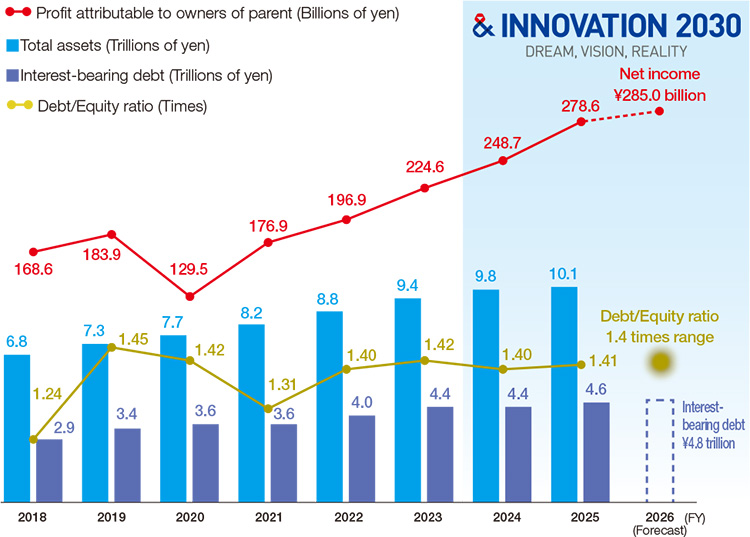
Real estate development and neighborhood creation–type businesses are characterized by the heavy long-term use of the balance sheet. Impacted by recent fluctuations in foreign currency exchange rates, Mitsui Fudosan’s total assets and interest-bearing debt stood at roughly ¥10.1 trillion and ¥4.6 trillion, respectively, as of the end of fiscal 2025. Against this backdrop, we are working to manage our balance sheet from a medium- to long-term perspective by accelerating asset turnover and realizing added value (valuation gains) as well as other means while remaining conscious of both leasing income and sales profit growth under “& INNOVATION 2030.” Recognizing that fluctuations in foreign currency exchange rates remain a factor, Mitsui Fudosan will work diligently to further enhance the quality and efficiency of its asset portfolio through not only the sale of fixed assets and real property for sale without exception but also the turnover of assets taking into consideration investment securities in their totality.
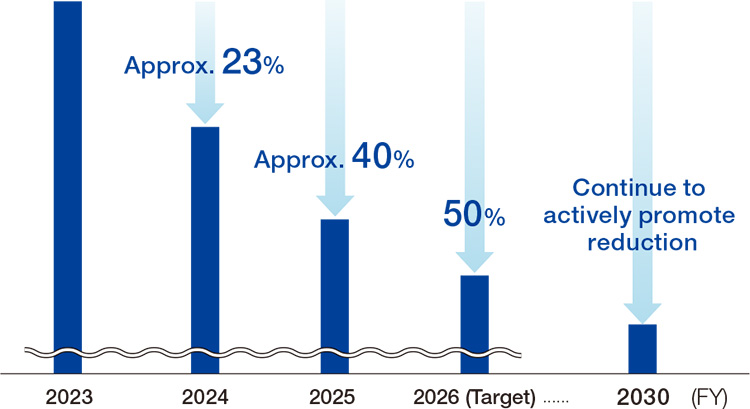
Turning to the strategic shareholding component of investment securities, we have identified the reduction target of 50% over the three-year period from fiscal 2024 to fiscal 2026 under “& INNOVATION 2030.” Moving forward, we will continue to actively reduce strategic shareholdings thereafter. As far as results are concerned, we reduced strategic shareholdings by roughly 40% in fiscal 2025 and expect a reduction of approximately 50% or more in fiscal 2026. Based on the aforementioned, we are on track to achieve our fiscal 2026 target.
In the case of shares held purely for investment purposes, we have decided to undertake their sales on an ongoing and flexible basis while continuing to take into consideration our track record to date and other factors, including future share prices with the aim of allocating proceeds to investments for future growth. Moving forward, we will continue to undertake timely sales in line with market conditions.
<Status and targets for the reduction of strategic shareholdings>
With long-term interest rates in Japan reaching their highest level in around 30 years and the lingering uncertainty that surrounds overseas market conditions against the backdrop of a high interest rate environment and geopolitical risks, we recognize that maintaining and strengthening a sound financial position and managing the Group’s net interest burden have become more important than ever for the stable continuation of our business.
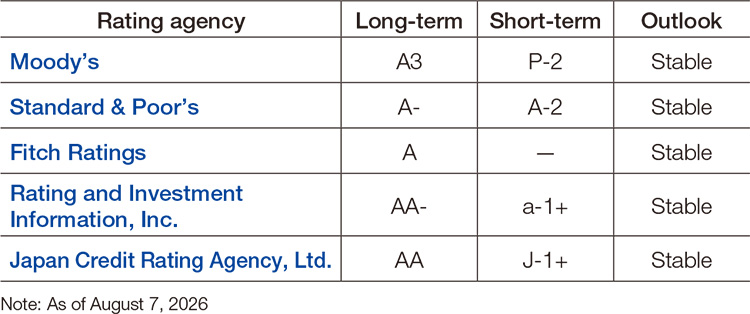
Under “& INNOVATION 2030,” our policy is to manage the D/E ratio at around 1.2–1.5 times in order to maintain an “A” rating from the major credit rating agencies. In line with this policy, the Company’s D/E ratio came in at 1.41 times in fiscal 2025. The D/E ratio is forecast to remain in the 1.4 times range in fiscal 2026. Looking ahead, Mitsui Fudosan will continue to control its financial leverage in an appropriate manner while prioritizing the maintenance of financial soundness.
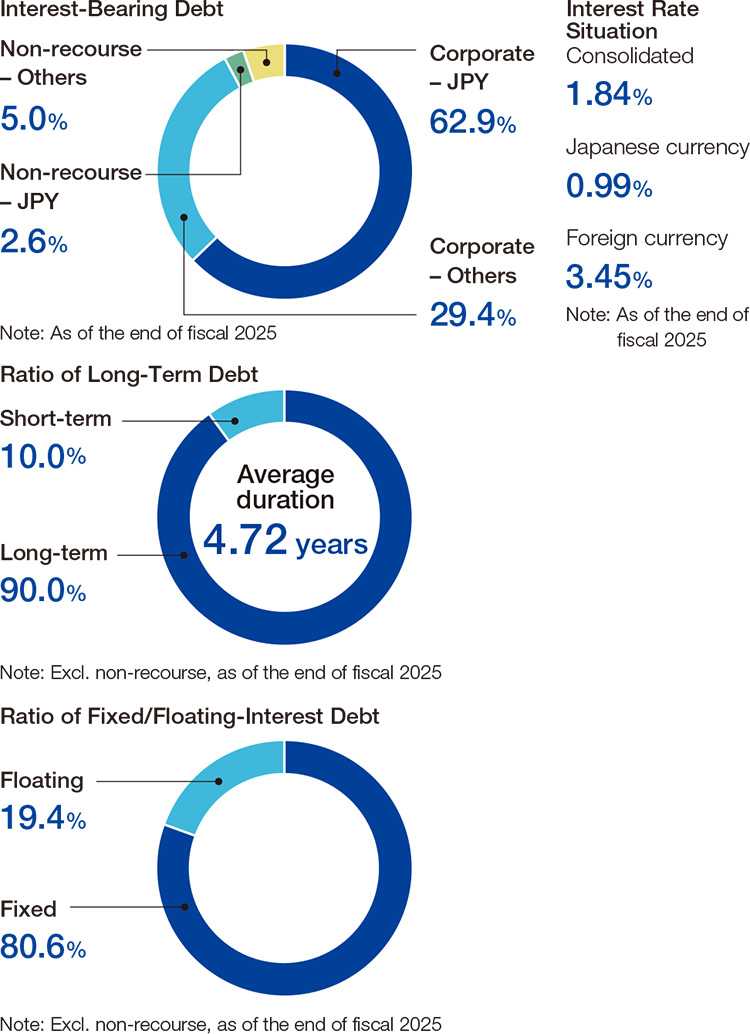
In light of recent interest rate trends in Japan and overseas, we have received a growing number of inquiries from investors regarding our projected net interest burden and funding policies. To mitigate risks such as financial market fluctuations during property development and limit the impact of interest rate hikes in Japan, we strategically maintain the vast majority of our yen-denominated borrowings on a long-term, fixed-rate basis.
In fiscal 2025, although our net interest burden increased due to higher interest rates in Japan, it came in at ¥73.4 billion, below our forecast of ¥75 billion, partly reflecting lower interest rates overseas. This was also the result of measures to reduce the net interest burden, including carefully selecting funding sources and methods and utilizing the interest rate differential between the yen and other foreign currencies in our funding while taking foreign exchange risks into account.
For fiscal 2026, we expect the interest burden to increase to ¥85 billion, reflecting progress in domestic and overseas investments and higher yen interest rates, as well as the continuation of a high-interest-rate environment overseas amid geopolitical risks, including in the Middle East, and inflation concerns.
Against the backdrop of a rising interest rate environment, we recognize that it is more important than ever to maintain financial soundness and appropriately manage funding costs.
We believe it is necessary to closely monitor future interest rate trends in each country, including Japan. As one of my key responsibilities as CFO, I will continue to respond flexibly to conditions by adjusting borrowing maturities and funding methods, while appropriately controlling interest rate risk and maintaining and enhancing financial soundness through measures such as diversifying funding sources and managing the balance between fixed and floating interest rates.
<Credit ratings>
<Status of fund procurement>
Raising Corporate Value and the Share Price by Steadily and Sustainably Improving ROE to a Level That Exceeds the Cost of Shareholders’ Equity
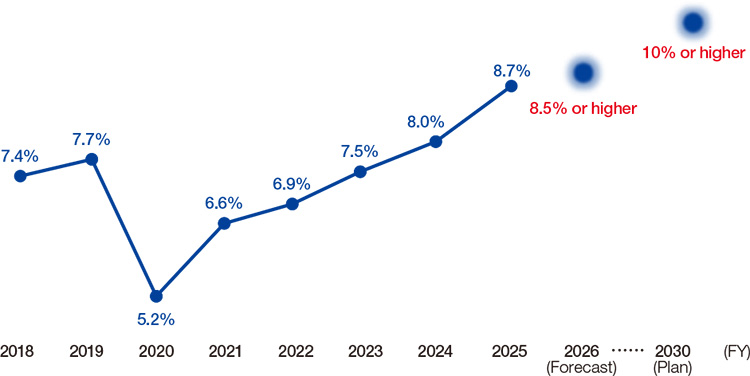
ROE is an important KPI that is used to measure efficiency when working to achieve profit growth through the use of capital placed with the Company by investors. Recognizing that we continue to face challenges regarding the level of our ROE, we set quantitative targets of 8.5% or higher in fiscal 2026 and 10% or higher around fiscal 2030 under “& INNOVATION 2030.” In fiscal 2025, the results of such initiatives as decoupling put forward under “& INNOVATION 2030” began to emerge with net income growing steadily. As a result, we achieved our fiscal 2026 ROE target one year in advance.
Promoting initiatives that focus on expanding net income growth, as the numerator, and controlling shareholders’ equity, as the denominator, are vital to improving ROE.
Turning first to the numerator, we have made progress in changing mindsets to focus on reflecting the added value we create in our prices by decoupling from the markets as outlined in “& INNOVATION 2030.” As a result, we reported record high business income in each of our four core “Leasing,” “Property Sales,” “Management,” and “Facility Operations” segments in fiscal 2025. At the same time, we achieved our fiscal 2026 business income and net income targets of ¥440 billion or higher and ¥270 billion or higher, respectively, through progress in the sale of investment securities one year ahead of schedule.
Turning to shareholders’ equity, the denominator, we are controlling its accumulation through measures such as the repurchase of shares in line with the new shareholder returns policy under “& INNOVATION 2030,” which sets a total payout ratio target of 50% or higher each fiscal year.
<Current status and future outlook for net income, total assets, and liabilities>
<ROE performance trend and future targets>
In addition, since last year Mitsui Fudosan has linked a portion of the compensation paid to directors, corporate officers, and others to EPS and ROE. As CFO, I am strongly committed to achieving sustained EPS growth and our ROE targets and will work to enhance corporate value through both profit and improved capital efficiency (P.79)
Turning to the cost of shareholders’ equity, I am acutely aware that there are various views on the subject. In 2024, when we announced “& INNOVATION 2030,” we indicated that the calculated cost of shareholders’ equity under the Capital Asset Pricing Model (CAPM), the most commonly used methodology, was around 7%. While we recognize that this figure has since risen to some extent due to higher interest rates, we believe that our actual cost of shareholders’ equity is lower than the mechanically calculated CAPM figure, given factors such as the stability of our business portfolio, the reliability of our cash flows, and our resilience to changes in the external environment. Accordingly, we believe our actual ROE of 8.7% in fiscal 2025 exceeded the cost of shareholders’ equity.
In any case, as CFO, I recognize the critical need to expand the equity spread between our ROE and cost of shareholders’ equity in order to enhance our corporate value and share price.
Moving forward, Mitsui Fudosan will continue to devote all of its energies toward achieving and improving each of its quantitative targets, including ROE, identified under “& INNOVATION 2030.” At the same time, we will work diligently to lower our capital cost through a variety of means, including proactive IR dialogue.
Continue to Engage in Proactive IR Dialogue
I recognize that in raising our corporate value and increasing our share price it is essential that investors have a deep understanding of our company. For that reason, I consider dialogue with investors to be one of my most important tasks as CFO.
Since becoming CFO in fiscal 2023, I have kept mutual dialogue very much in mind, holding numerous meetings with investors, listening directly and frankly to their opinions, and explaining the Company’s thinking.
In addition to elaborating on progress toward achieving “& INNOVATION 2030,” Mitsui Fudosan focused on further enhancing the quality of dialogue with investors in fiscal 2025. While engaging in more in-depth discussions on such topics as growth investments and our approach toward shareholder returns, we took steps to strengthen interaction and communication by incorporating the feedback received into management deliberations and the consideration of initiatives.
As CFO, I have also personally spoken at briefings for individual investors to explain our initiatives. In addition, we are strengthening our engagement with individual investors by disseminating corporate information through online media aimed at this audience. Going forward, with a particular focus on creating both social and economic value, we will strengthen communication about our competitive advantages and differentiation strategies, our ESG initiatives, the resilience of our asset portfolio, and the stability and continuity of future performance.
This year marks my fourth year as CFO. Now that we have achieved our fiscal 2026 targets one year ahead of schedule, I recognize that capital allocation and financial strategy with an eye to the next stage of growth are more important than ever. We are discussing within the Company strategies to achieve the fiscal 2030 targets set out in “& INNOVATION 2030.” As inflation ushers in a world of positive interest rates, I will lead the Company as CFO in steadily advancing management that integrates growth, efficiency, and shareholder returns. Through further enhancing IR dialogue, I will deepen relationships of trust with investors and other stakeholders and contribute to a higher share price by enhancing corporate value.